How the IPL Auction Works: A Simple Fan Guide

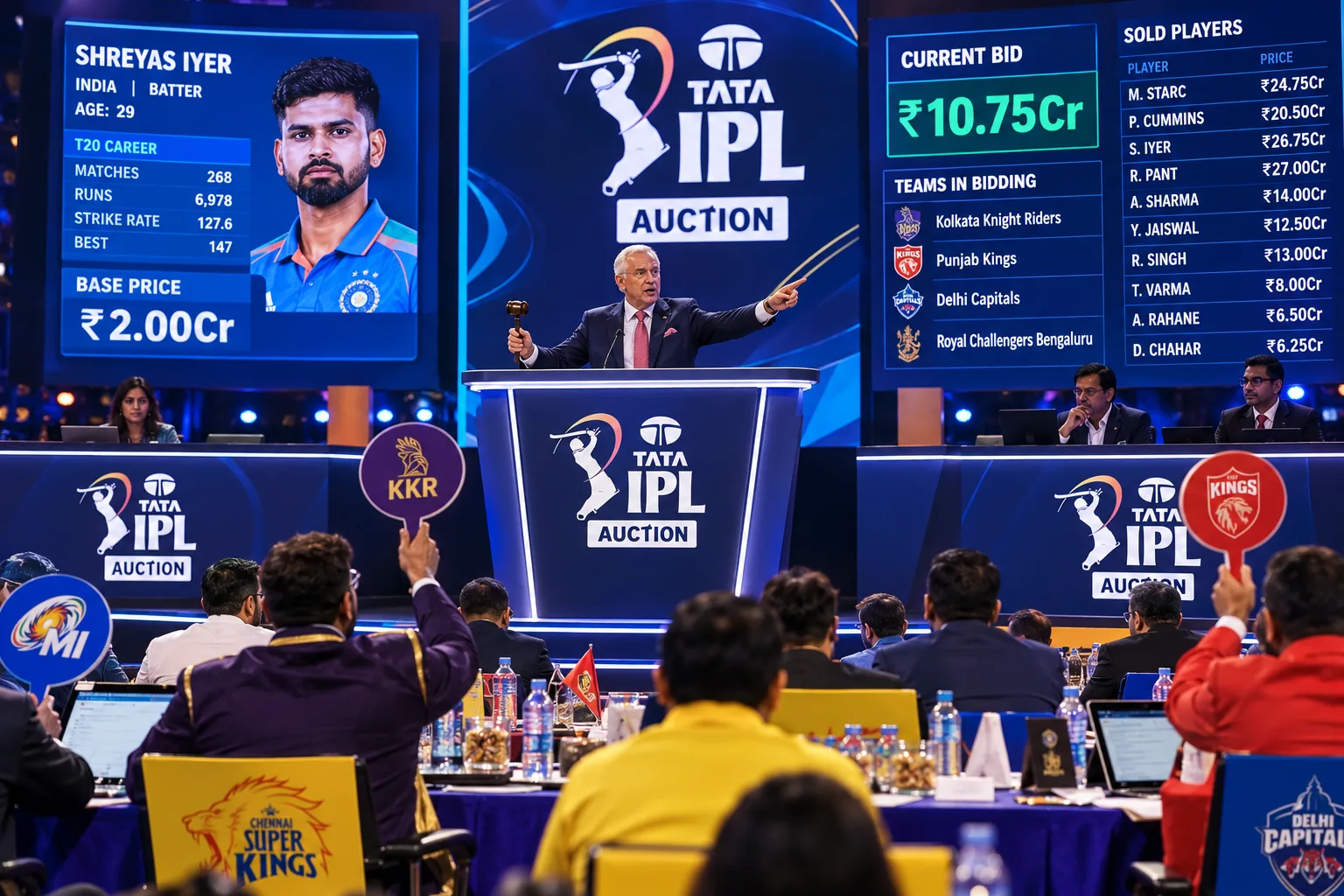
Every year, for one long day, cricket stops being about sixes and yorkers and turns into something closer to a chess match with a paddle. Team owners huddle, coaches scribble notes, and an auctioneer's gavel decides where some of the best players in the world will spend their next season. If you have ever watched the IPL auction on TV and wondered why a franchise suddenly throws a fortune at one name while letting another go cheap, you are not alone. It looks chaotic, but underneath there is a tidy set of rules.
Once you understand those rules, the auction becomes a proper spectator sport in its own right. You start spotting the strategy, the bluffs, the moments a team gets backed into a corner. So let us slow it down and go through it piece by piece, the way a friend would explain it over chai.
The purse: every team's shopping budget
Each franchise walks into the auction with a fixed amount of money to spend, and that amount is the same for everyone. This pot is called the purse, and it ties into a wider idea called the salary cap, a ceiling on what a team can commit to its whole squad. The league sets this figure and raises it over the years, which is why player prices keep climbing.
The money that matters is what is left after retentions. Whatever a team spends keeping its existing players gets subtracted from the purse, so the balance it carries into the room is smaller than the headline figure. Manage it well and you build a balanced side. Blow most of it on two superstars and you may be scrambling to fill the bench with bargains.
Retentions and the RTM card
Before a big auction, teams are allowed to retain a handful of players from their previous squad. Retention means you lock in a player without anyone else getting a chance to bid, but it costs you a pre-set slice of your purse, and the bigger the star, the bigger the slice.
Then there is the clever bit: the Right to Match card, usually shortened to RTM. Say a team chose not to retain a player, and that player goes up for auction. If a rival wins the bidding, the original team can play its RTM card to match that final price and take the player back. It is a safety net for someone you quietly still wanted. Teams get a limited number of these cards, so they use them carefully.
Capped, uncapped and the base price
Players enter the pool with a base price, the minimum bid at which they can be bought. A proven international star might set a high base price, while a youngster trying to break in sets a modest one, hoping interest from more than one team pushes it up.
You will also hear the terms capped and uncapped. A capped player has represented his country at senior international level; an uncapped player has not. Uncapped players, often young domestic talents, usually come at lower prices, which makes them brilliant value when a team spots someone before the rest of the room does. Plenty of IPL success stories started as unknown uncapped names bought for next to nothing.
The bidding war: where the drama lives
This is the part everyone tunes in for. The auctioneer calls a name, states the base price, and teams raise their paddles. Prices climb in fixed steps. When two or three franchises really want the same player, the number can shoot up fast, and the room gets tense.
Smart teams do not just chase names. They watch who is still active, how much each rival has left to spend, and whether a player fills a genuine gap. A few things usually decide how hard a team pushes:
- Squad needs — are they short on a death bowler, an opener, a finisher?
- Money remaining — can they commit fully now, or must they save for later names?
- Overseas balance — more on that next, because it quietly shapes everything.
Cricket shifted once franchise auctions became the norm, and the way teams value specialists shifted with it. If that side of the game interests you, our look at how T20 cricket changed the game is a good companion read.
The overseas player limit
Here is a rule that catches new fans out. A team can sign plenty of overseas players, but only four of them can take the field in the playing eleven on match day. So a franchise has to think ahead: there is no point stacking seven foreign stars if only four can play at once.
This limit is exactly why Indian uncapped talent is so prized. Strong local players let a team spend its overseas slots on genuine match-winners while filling the rest of the side with home-grown depth. It keeps the competition rooted in Indian cricket rather than becoming an all-star import show.
Mega auction vs mini auction
Not every auction is the same size. Every few years there is a mega auction, where teams release most of their squads and rebuild almost from scratch. These are long, day-filling affairs with hundreds of players on the list. In the years between, teams hold a smaller mini auction, mostly to patch gaps, replace a retiring player or add one or two fresh faces.
Mega auctions reshape the whole league; mini auctions are more like fine-tuning. If you want the fuller backstory of how all this grew, the history of the IPL gives plenty of context on how the format took shape.
Bringing it together
Once you know the moving parts, the purse, retentions, RTM, base prices, the overseas cap and the gap between a mega and a mini auction, the whole event clicks into place. You stop seeing random big numbers and start seeing plans unfold. If you like keeping every fixture and live score in one place through the season that follows, an IPL cricket id makes following along simple. Next auction day, put the pieces together yourself and watch how your team plays the room.