Cricket Stats Explained: Average, Strike Rate, Economy

You are watching a match, the commentator says a batter is averaging 52 with a strike rate of 88, and the bowler at the other end has an economy of 4.3. If those numbers wash over you, you are not alone. Most of us fall for cricket through sixes, yorkers and tense run chases long before we work out what the figures on screen actually mean.
Here is the reassuring part: the core statistics are much simpler than they sound. Learn five basic numbers and you can glance at almost any player's record and get a fair read on how good they are, and in which situation. We will take them one at a time, with the plain formula and, just as useful, a feel for what counts as a strong number in each format.
Batting average: runs before you get out
A batter's average is the easiest place to begin. It tells you how many runs, on average, they score each time they are dismissed.
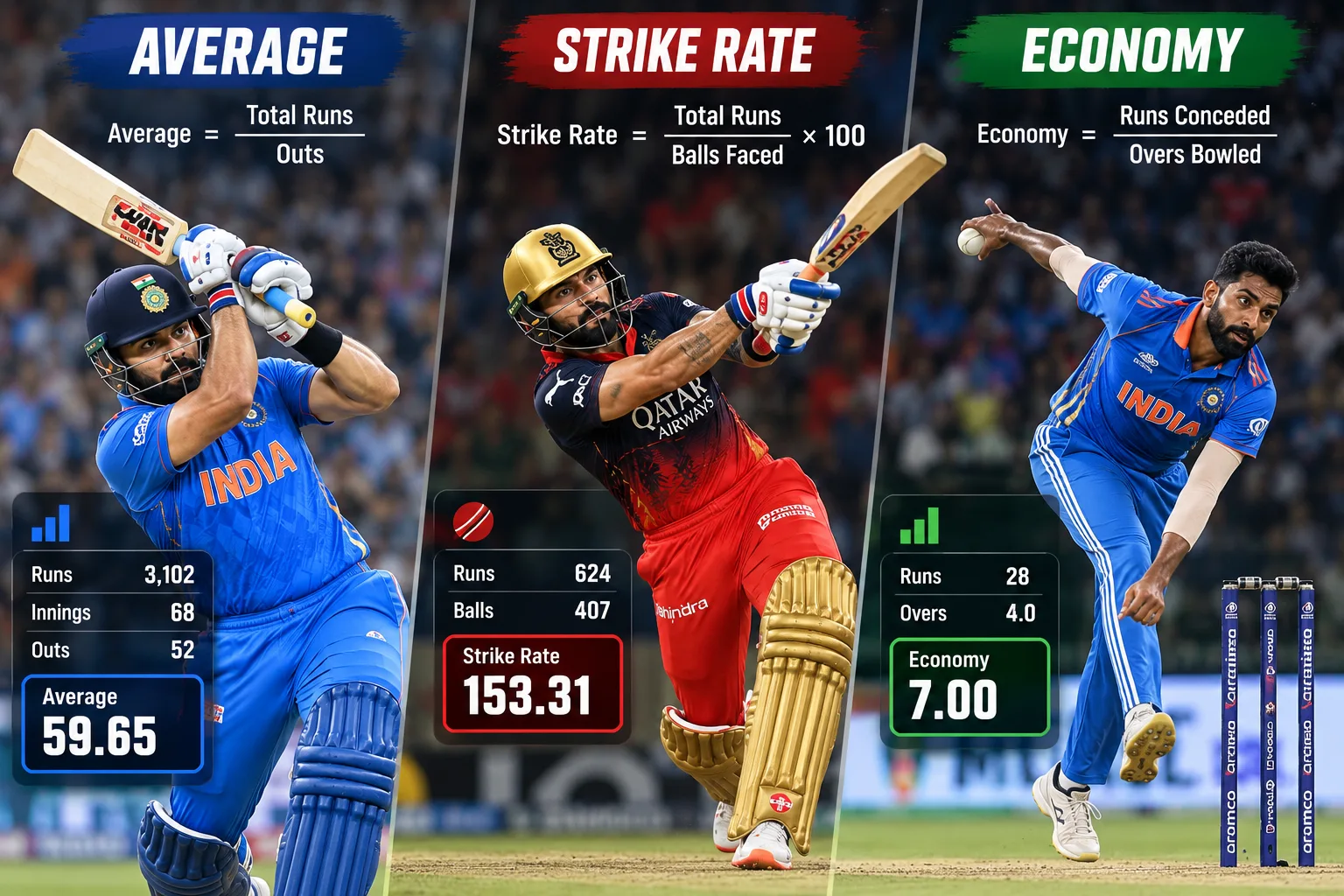
Formula: total runs divided by number of times out. A batter with 1,000 runs who has been dismissed 20 times averages 50. Not-out innings do not count as a dismissal, which is why finishers who often stay unbeaten tend to carry healthy averages.
So what is a good average? It leans heavily on the format:
- Test cricket: an average above 50 marks a top-class batter, and the all-time greats sit higher still.
- ODIs: anything from the mid-40s upward is excellent for a frontline batter.
- T20s: averages matter less here, because batters take more risks, so a figure in the 30s can still belong to a genuinely dangerous player.
Batting strike rate: how fast those runs come
Average tells you how many runs. Strike rate tells you how quickly they arrive, and in the shorter formats that pace can count for as much as the volume.
Formula: runs divided by balls faced, multiplied by 100. A strike rate of 150 means 150 runs for every 100 balls, a shade over a run and a half per delivery.
Rough guide: a Test batter scoring at 50 to 60 is perfectly fine, because time is on their side. In ODIs, 85 to 95 is solid and the big hitters sail past 100. In T20s, you want 130 and up from an attacking player. The real trick is to read average and strike rate together. A high average with a modest strike rate usually means an anchor; a lower average with a sky-high strike rate points to a bold finisher who lives on the edge.
Bowling average and strike rate: the cost and frequency of wickets
Bowlers have their own version of these numbers, and here a lower figure is the better one.
Bowling average
Formula: runs conceded divided by wickets taken. It is the price, in runs, of each wicket. A bowler who gives up 600 runs for 30 wickets averages 20, which is very good. In Test cricket, an average under 25 signals a high-quality bowler.
Bowling strike rate
Formula: balls bowled divided by wickets taken. This shows how often a bowler strikes. A strike rate of 50 means a wicket roughly every 50 balls, a little over eight overs. Partnership-breakers tend to post lower numbers here, whether they rely on raw pace or patient, probing spin and pace.
Economy rate: how tight the bowling is
In limited-overs cricket, choking off runs can be as valuable as taking wickets, and economy rate is the number that captures it.
Formula: runs conceded divided by overs bowled. It is simply the average runs a bowler gives away per over. An economy of 4.3 means roughly four and a bit runs an over.
- ODIs: anything under 5 is tidy, and the best go lower through the middle overs.
- T20s: under 7 is genuinely good, given batters are swinging freely.
Watch how economy swings within an innings, too. A bowler can leak runs in the powerplay yet bowl beautifully at the death, so a single season-long figure rarely tells the whole story.
Reading the numbers live during a match
This is where everything clicks into place. During a chase, check the batter's strike rate to judge whether they are keeping up with the required rate. Glance at a bowler's economy for the day to see who the captain trusts to stem the flow. Look up a new batter's career average to sense how settled, or how shaky, the innings really is.
All of this lives on the scorecard, so it pays to know your way around one, and our guide on how to read a cricket scorecard breaks it down clearly. If you like keeping every fixture and live score in one place, setting up a cricket id makes following along a lot simpler.
Putting it together
Numbers are not meant to replace the joy of a well-timed cover drive. They are a shortcut to understanding what you are watching: why a captain throws the ball to one bowler over another, or why a batter suddenly shifts through the gears. Learn these five figures, notice how they move across Tests, ODIs and T20s, and the game quietly opens up. Next match, keep half an eye on the stats, and the story behind the scoreline starts to show itself.