Cricket World Cup History: The Champions Story
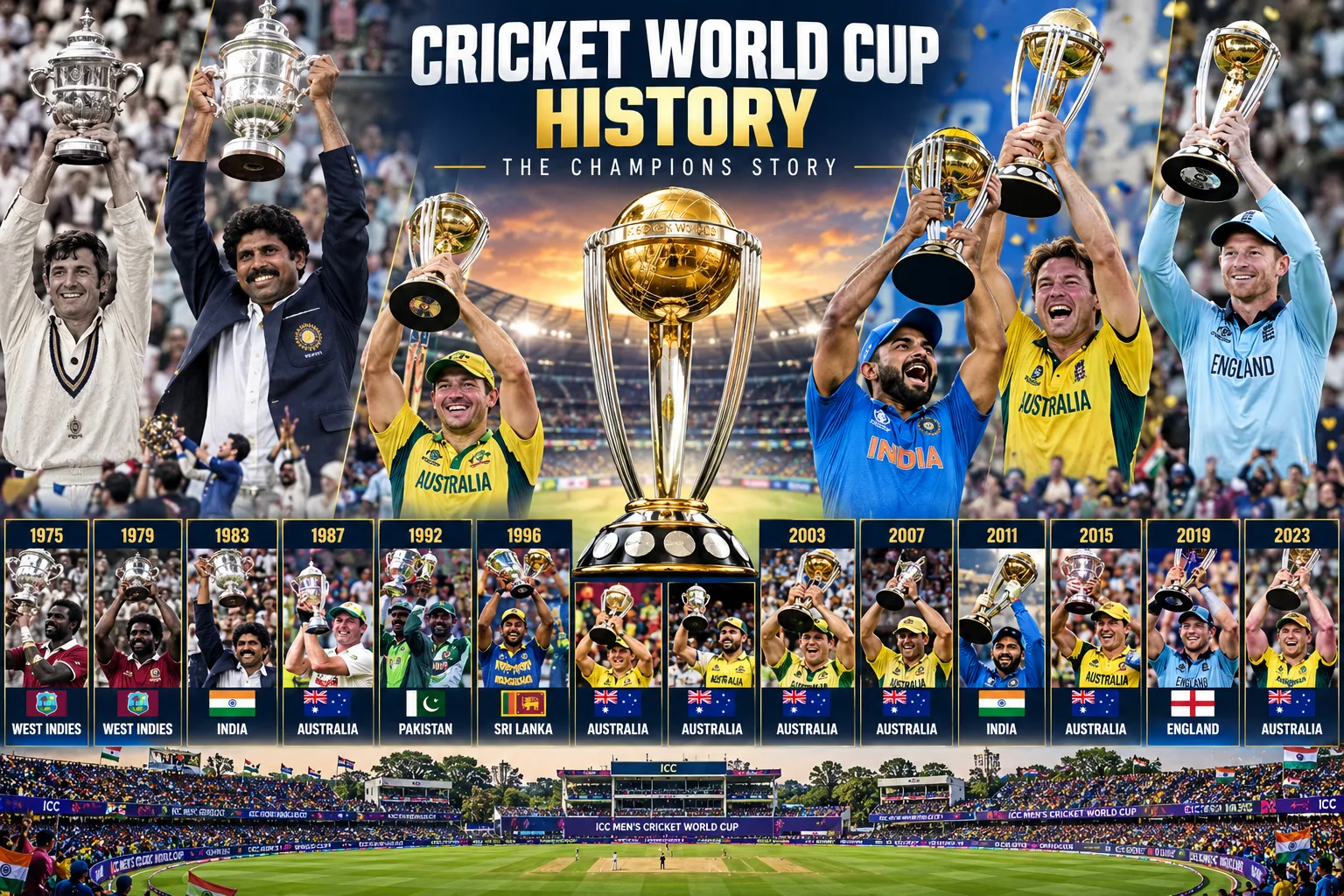
Every four years, cricket quietens its packed calendar and gathers everyone around one trophy. The ODI World Cup is the tournament fathers describe to their children, the one that fills living rooms, office canteens and roadside dhabas, and the one that turns ordinary afternoons into memories people carry for decades. Since the very first edition in 1975, it has handed us some of the sport's most unforgettable nights.
If you have ever wondered how the list of champions actually stacks up, or why certain teams are spoken about with a little extra respect, this is for you. We will walk through the competition from its early days to the modern era, keeping our eyes on the sides that lifted the trophy and the matches that turned good teams into legends. Along the way you will see how the one-day game grew up, and why it still feels special compared to the other formats of cricket.
Where it all began: the West Indies era
The first two World Cups, in 1975 and 1979, belonged almost completely to the West Indies. This was a side packed with fearsome fast bowlers and batsmen who hit the ball harder than anyone had seen. Under Clive Lloyd, they won the inaugural final at Lord's against Australia, with Lloyd himself playing a blazing innings that set the tone for a generation.
Four years later they did it again, beating England in the 1979 final, with Viv Richards in imperious touch. For a while it looked like nobody could get near them. They were quick, confident and miles ahead of the pack. That aura is exactly what made the next chapter so remarkable.
India 1983: the day everything changed
Few teams were given less of a chance than Kapil Dev's India in 1983. Yet on a June afternoon at Lord's, they bowled out the two-time champions West Indies to win by 43 runs and stun the cricketing world. India had posted a modest total, but their bowlers kept their nerve and the fielders held their catches when it mattered most.
That win did more than put a trophy in the cabinet. It lit a fire under cricket back home, pulled a whole country towards the one-day game, and quietly began the shift that would eventually make India the commercial heart of the sport. A huge part of what followed, including the rise of franchise cricket in India, traces back to the belief that 1983 created.
Australia's golden run
If one nation has defined the World Cup more than any other, it is Australia. Their story began in 1987, when they edged England in a tight final in India to win their first title. But it was the period from 1999 onwards that became genuinely special.
Under captains like Steve Waugh and later Ricky Ponting, Australia won three tournaments in a row in 1999, 2003 and 2007, often without even looking troubled. They had depth in every department, aggressive batting and a ruthless streak that wore opponents down. They added further titles in later years too, making them comfortably the most successful side in the competition's history. When people talk about a dynasty in one-day cricket, this is the team they mean.
Champions from every corner
The World Cup has never belonged to just the biggest names, and some of its most loved winners came from unexpected places.
- Pakistan, 1992: Imran Khan's side started poorly but surged through the second half of the tournament, playing with real flair to beat England in the final.
- Sri Lanka, 1996: A fearless, inventive team changed how batsmen used the early overs and lifted the trophy on the subcontinent, a result that still inspires smaller cricketing nations.
- England, 2019: After decades of near misses, the hosts finally won a dramatic final that went all the way to the closest possible finish, a night that showed just how fine the margins can be.
India 2011 and the roll of honour
For an entire generation of Indian fans, 2011 is the memory that outshines the rest. Playing at home, MS Dhoni's team beat Sri Lanka in the Mumbai final, with Dhoni himself finishing things off with a six that is replayed to this day. Winning on home soil, in front of a roaring Wankhede crowd, carried a weight that is hard to put into words.
Here, in short, are the sides that have tasted glory across the tournament's history:
- West Indies — the early kings of 1975 and 1979
- India — the underdogs of 1983 and the home heroes of 2011
- Australia — the most decorated champions of all, with a run of titles from 1987 onwards
- Pakistan (1992), Sri Lanka (1996) and England (2019) — proof that fresh thinking and belief can topple the favourites
Half the fun of a World Cup year is simply keeping up with every warm-up, group game and knockout without missing a beat. If you like keeping all your fixtures and live scores in one place, a cricket id makes following along a lot simpler. It also helps to brush up on how qualification works before the next edition, which the guide on ODI World Cup 2027 qualification breaks down nicely.
What the champions story really tells us
Look across the decades and a clear thread appears. The World Cup rewards teams that stay calm under pressure, that field brilliantly, and that believe they belong even when few give them a chance. From the power of the early West Indies to Australia's machine-like consistency and India's two famous triumphs, every champion added something to the game's story. The trophy keeps changing hands, the heroes keep changing names, and that is exactly why we keep coming back every four years.